Dr. Mubbashir Rizvi
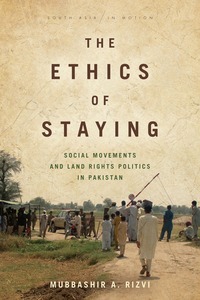
I am a Professorial Lecturer in the Department of Anthropology at American University. I got my Ph.D in Social-Cultural Anthropology from the University of Texas-Austin, and a BA from Brooklyn College, City University of New York. My research and teaching interests span a range of topics; social movements, environmental justice, indigenous and peasant land rights, postcolonial militarization, race and empire. My book, the Ethics of Staying: Social Movements and Land Rights in Pakistan (Stanford University Press May 2019), examines the rise of a land rights movement that challenged the Pakistani military’s policy to privatize state-owned farms. I examine the role of social movements and technological change in shaping political agency in rural Pakistan. My publications analyze the relationship between moral economy and infrastructure projects. I have documented the instrumental use of counter-terrorism policies to suppress peasant/indigenous demand for land rights’ and my recent article in “A Divided Movement” examines the complexities arising from civil society/ NGO involvement in grassroots struggles. My peer-reviewed publications appear in History and Anthropology, Anthropology Today, South Asian History and Culture, Verge and Text, Performance and Practice.
I am currently working on several projects that bring together histories of race, ethnicity and the environment. My current research focus is on Karachi’s food geographies in creating the conditions of coexistence and commensality in the aftermath of ethnic riots and sectarian violence. I am also working on a research essay, “Decolonizing Georgetown through Memory Walks” is a study of historical memorialization and silencing of Georgetown’s indigenous communities, and black laborers in discussion of reparations. I recently published a research essay, “Soul to Soul: Black Expressive Cultures in the Fight Against the Muslim Ban.” This essay goes behind and beyond the debate on the “Muslim ban” to argue that the most effective challenges to any racial ban will come from a sustained cultural and political engagement with the long history of Islam in America, starting from the first enslaved African Muslims in the 16th century.
I am a founding member of BOL– a worker-owned bookstore project rooted in a vision: worker ownership, free exchange of ideas, and political empowerment. I am one of four coop members who are working to build BOL into a community hub for exchange of ideas, book clubs, workshops for liberation and collective study in the heart of the Empire. We are currently operating as a pop-up in the Creative Grounds Cafe at 1822 North Capitol Ave.
Research and Scholarship
Chapati Mystery: A Conversation with Mubbashir Rizvi. An interview on research and scholarship. with Madhuri Karak
Research Projects
XQs XVIII – A Conversation with Mubbashir Rizvi
Interview on Chapati Mystery. Academic Blog:The XQs (Ten Questions) series is a conversation with the authors of new and exciting works in South Asian Studies, whose aim is not to ”review” but to contextualize, historicize, and promote new scholarship. We thank Madhuri Karak for conducting this interview
Book
Mubbashir A. Rizvi. Ethics Of Staying: Social Movements And Land Rights Politics In Pakistan. Stanford University Press, 2019.
Articles in Journals
Rizvi M, Akhter M, Khan N, Dadi I. Critical Forum: What is Critical Pakistan Studies? Critical Pakistan Studies. 2023;1(1-2):4-13. doi:10.1017/cps.2024.2
Mubbashir Rizvi. “Colonial Infrastructure And The Politics Of Partition Of Punjab.” Verge: Studies In Global Asias, 6, 2 (2020): 34. DOI: DOI: 10.5749/vergstudglobasia.6.2.0034.
Mubbashir Rizvi. “A Divided Movement: Urban Activists, Ngos, And The Fault-lines Of A Peasant Struggle.” South Asian History And Culture, 10, 3 (July 3, 2019): 295-308. DOI: https://doi.org/10.1080/19472498.2019.1649941.
Mubbashir Rizvi. “From Terrorism To Dispossession: Pakistan’s Anti-terrorism Act As A Means Of Eviction.” Anthropology Today, 34, 3 (June 1, 2018): 15-18. DOI: https://rai.onlinelibrary.wiley.com/doi/full/10.1111/1467-8322.12434.
Mubbashir Rizvi. “The Moral Ecology Of Colonial Infrastructure And The Vicissitudes Of Land Rights In Rural Pakistan.” History And Anthropology, 28, 3 (May 27, 2017): 308-325. DOI: https://doi.org/10.1080/02757206.2016.1253566.
Rizvi, Mubbashir. “Multiple Lives of Black Islam in Hip Hop.” Text, Performance and Practice, VIII (2009): 95-110.
Edited Books or Special Edition Journals (1)
Radhika Govindrajan, Bhoomika Joshi and Mubbashir Rizvi, ed. Majoritarian Authoritarianism in South Asia. Society for Cultural Anthropology, 2021.
Internet Publications (3)
Mubbashir Rizvi, “Soul to Soul: Black Expressive Culture in the Fight Against the Muslim Ban,” ACMCU, 2020, https://acmcu.georgetown.edu/2020/06/02/soul-to-soul-black-expressive-culture-in-the-fight-against-the-muslim-ban/.
Mahduri Karak, and Mubbashir Rivi, “Ten Questions: A Conversation with Mubbashir Rizvi,” Chapati Mystery, 2019, https://www.chapatimystery.com/archives/xqs_xviii_-_a_conversation_with_mubbashir_rizvi.html.
Mubbashir Rizvi, “Dispossession in the Name of Security,” Tanqeed, 2014, https://www.tanqeed.org/2014/07/dispossession-in-the-name-of-security/.
Expertise
Agriculture- Environmental Livelihood, Environmental History, Global History, Infrastructure, Political Anthropology, Postcolonial Theory, Race and Ethnicity, South Asia
Research Techniques
Oral History, Participant Observation, Qualitative Research Methods
Founding Member: Bol Worker Owned Bookstore
 Mubbashir Rizvi